Executive Summary
Selecting the right Contract Lifecycle Management (CLM) solution is one of the most critical technology decisions your organization will make. With contracts touching every aspect of business operations, from procurement and sales to legal and finance, the stakes couldn’t be higher. A well-crafted Request for Proposal (RFP) serves as your roadmap to finding a CLM partner that aligns with your unique needs, accelerates time-to-value, and delivers measurable ROI.
This guide provides legal, revenue, IT and procurement teams with a structured approach to creating, evaluating, and leveraging RFPs in the CLM selection process. Whether you’re replacing legacy systems or implementing CLM for the first time, these insights will help you avoid common pitfalls, ensure internal processes are in a good place, and make a confident, data-driven decision.
Part 1: Introduction – Why Your CLM RFP Matters More Than You Think
The Hidden Complexity of CLM Selection
Contract management isn’t just a legal function anymore, it’s a business-critical capability that impacts revenue recognition, risk mitigation, compliance, and operational efficiency. Modern CLM platforms promise to transform how organizations create, negotiate, execute, and manage contracts. But with dozens of vendors claiming similar capabilities, how do you cut through the noise?
The answer lies in a strategic, well-structured RFP process. Unlike generic software evaluations, CLM selection requires balancing diverse stakeholder needs across legal, procurement, sales, IT, and finance. Each group brings different priorities, from legal’s focus on risk and compliance to sales’ need for speed and IT’s requirements around security and integration.
Why an RFP Ensures Better Vendor Alignment
A comprehensive RFP does more than just gather vendor information, it forces internal alignment on what success looks like. By documenting your requirements upfront, you create a framework for:
- Objective Comparison: Standardized responses enable apples-to-apples vendor evaluation
- Stakeholder Buy-in: Cross-functional involvement ensures all voices are heard
- Risk Mitigation: Clear requirements reduce implementation surprises
- Negotiation Leverage: Documented needs strengthen your position during contract discussions
- Future-Proofing: Scalability requirements ensure your solution grows with your business
- Cost & ROI Transparency: Comparable pricing and ROI models reveal total cost of ownership
- Governance & Compliance Assurance: Verifies solutions meet security, audit, and regulatory obligations
Part 2: Why RFPs Matter When Searching for a CLM Solution
Balancing Diverse Business Needs
Your CLM solution must serve multiple masters. General Counsel needs robust compliance features and audit trails. Sales leadership wants to accelerate deal velocity. Procurement requires spend visibility and effective supplier management. IT demands secure integrations and minimal technical debt. Without a structured RFP, these competing priorities can derail your selection process.
Consider how different stakeholders view the same CLM capability:
Contract Templates
- Legal sees standardization and risk mitigation
- Sales sees faster deal creation
- Procurement sees negotiation leverage
- Finance sees cost control through standard terms
A well-designed RFP captures these multifaceted requirements, ensuring your chosen solution delivers value across the enterprise.
Driving Transparency and Comparability
CLM vendors use different terminology, architectures, and deployment models, with “AI-powered” capabilities ranging from basic keyword extraction to advanced generative AI with semantic understanding, and now fully agentic systems that can autonomously negotiate terms and orchestrate workflows. Some vendors deploy native LLMs with retrieval-augmented generation (RAG), others integrate third-party models from providers like OpenAI, and many still rely on rules-based automation, making it critical to understand whether you’re evaluating pattern matching, generative AI, or autonomous agents.
Your RFP creates a common language, ensuring vendors explain their capabilities in your terms, not their marketing speak.
Key areas where standardized RFP responses drive clarity:
- AI and Automation: Specific capabilities vs. vague promises
- Integration Methods: Native connectors vs. API requirements
- Implementation Timeline: Realistic phases vs. optimistic projections
- Support & Service Levels: Clear SLAs vs. undefined commitments
- Security & Compliance: Verified certifications vs. generic assurances
- Total Cost of Ownership: All fees disclosed vs. hidden costs
The Cost of Getting It Wrong
Failed CLM implementations waste more than money, they erode trust in technology and delay digital transformation. Common consequences of poor vendor selection include:
- Shadow IT: Users revert to email and spreadsheets
- Integration Nightmares: Incompatible systems create data silos
- Adoption Failure: Complex interfaces drive user resistance
- Scalability Issues: Solutions that can’t grow with your needs
- Hidden Costs: Unexpected fees for customization and support
Part 3: Key Components of a CLM RFP
1. Business Objectives & Pain Points
Start with the “why” before diving into the “what.” Document your current challenges and desired outcomes to help vendors understand your context. Vendors that want to act as your strategic partner will want to use this information to best advise you on how their solutions present opportunities to solve or mitigate your current pain points.
Current State Assessment
Carefully assess the ‘as is’ operating model for contracting within your organization. Document current processes, org structure, technology landscape, and review existing policies and procedures. Conduct a contracting maturity assessment to determine where your overall maturity sits today and where you would like it to be in the future. Create the business case for change and align cross-functional stakeholders on the vision for the programme.
In turn, start collecting as much data about your contracting taxonomy as possible, including:
- Contract Categories (i.e. buy-side, sell-side, confidentiality)
- Contract Types (i.e. MSA, PSA, SOW, NDA)
- Templates per Contract Type
- Contract Volumes
- Approval Matrix / Delegations of Authority
- Master Data Requirements
- Number of users and their roles
Future State Vision
Define your technology-agnostic framework for contracting. What does ‘best-in-class’ contracting look like for your business? What is your contracting strategy? How does this fit into the broader strategic goals and vision of the enterprise? Establish:
- Quantifiable goals (e.g., reduce cycle time by 50%)
- Process improvements (e.g., eliminate manual data entry)
- Compliance requirements (e.g., GDPR, SOX, industry regulations)
- Scalability needs (e.g., support 2x volume in 18 months)
- Integration requirements (e.g: CRM, ERP, S2P)
2. Functional Requirements
Detail the specific capabilities your CLM solution must provide. Organize requirements by workflow stage and user persona. Be as detailed as possible – every vendor will say they have a repository or can generate contracts from templates. Reference complex real world business examples / processes which may stress-test vendors to ensure you are going to find the right partner / fit.
Here are some initial starting points / examples:
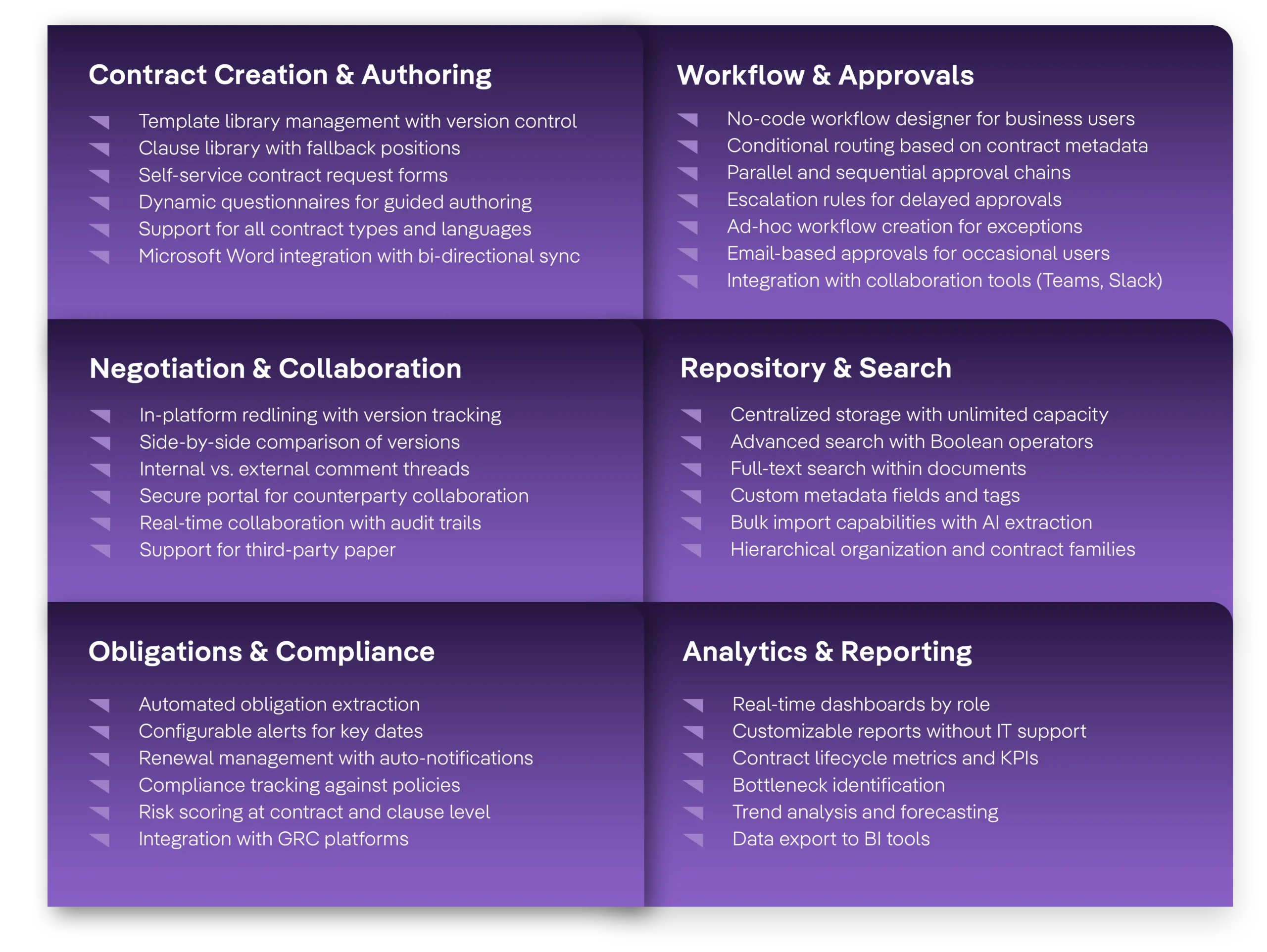
Contract Creation & Authoring
- Template library management with version control
- Clause library with fallback positions
- Self-service contract request forms
- Dynamic questionnaires for guided authoring
- Support for all contract types and languages
- Microsoft Word integration with bi-directional sync
Workflow & Approvals
- No-code workflow designer for business users
- Conditional routing based on contract metadata
- Parallel and sequential approval chains
- Escalation rules for delayed approvals
- Ad-hoc workflow creation for exceptions
- Email-based approvals for occasional users
- Integration with collaboration tools (Teams, Slack)
Negotiation & Collaboration
- In-platform redlining with version tracking
- Side-by-side comparison of versions
- Internal vs. external comment threads
- Secure portal for counterparty collaboration
- Real-time collaboration with audit trails
- Support for third-party paper
Repository & Search
- Centralized storage with unlimited capacity
- Advanced search with Boolean operators
- Full-text search within documents
- Custom metadata fields and tags
- Bulk import capabilities with AI extraction
- Hierarchical organization and contract families
Obligations & Compliance
- Automated obligation extraction
- Configurable alerts for key dates
- Renewal management with auto-notifications
- Compliance tracking against policies
- Risk scoring at contract and clause level
- Integration with GRC platforms
Analytics & Reporting
- Real-time dashboards by role
- Customizable reports without IT support
- Contract lifecycle metrics and KPIs
- Bottleneck identification
- Trend analysis and forecasting
- Data export to BI tools
3. AI & Automation Features
Modern CLM platforms leverage artificial intelligence to accelerate processes and reduce risk. Be specific about AI requirements to avoid “AI-washing.”
Essential AI Capabilities
- Automated contract review and risk identification
- Intelligent clause extraction from legacy contracts
- Smart redline suggestions based on playbooks or guidelines
- Natural language search and Q&A
- Predictive analytics for negotiation outcomes
- Automated contract classification and tagging
Advanced AI Features
- Generative AI for first draft creation
- Multi-language support with translation
- Sentiment analysis for negotiation insights
- Anomaly detection for unusual terms
- Continuous learning from user feedback
- Integration with GPT models for enhanced capabilities
4. Integration Requirements
Your CLM doesn’t exist in isolation. Document all systems that must connect with your CLM platform.
Priority Integrations
- ERP Systems: SAP, Oracle, NetSuite, Workday
- CRM Platforms: Salesforce, HubSpot, Microsoft Dynamics
- E-Signature: DocuSign, Adobe Sign, native capabilities
- Document Management: SharePoint, Box, Google Drive
- Collaboration Tools: Microsoft Teams, Slack, email
- Business Intelligence: Tableau, Power BI, Looker
Integration Methods
- Pre-built connectors vs. custom APIs
- Real-time vs. batch synchronization
- Bi-directional data flow requirements
- Error handling and retry logic
- Security protocols for data transfer
5. Security & Compliance
With contracts containing sensitive business information, security isn’t optional. Specify your requirements clearly.
Security Standards
- SOC 2 Type II certification
- ISO 27001 compliance
- GDPR and CCPA readiness
- Industry-specific requirements (HIPAA, PCI-DSS)
- Penetration testing frequency and reports
Access Controls
- Single Sign-On (SSO) with SAML 2.0
- Multi-factor authentication (MFA)
- Role-based permissions (RBAC)
- Field-level security controls
- IP restrictions and geofencing
Data Management
- Encryption at rest and in transit
- Data residency options
- Backup and disaster recovery procedures
- Data retention and purging policies
- Audit logs with immutable records
6. Implementation & Support
The best CLM platform poorly implemented is worse than no CLM at all. Define your implementation and support expectations.
Implementation Requirements
- Typical timeline for organizations your size
- Phased vs. big-bang approach options
- Data migration strategy and tools
- Change management methodology
- Success metrics and checkpoints
Training & Adoption
- Role-based training programs
- Administrator certification
- End-user documentation and videos
- Sandbox environment for practice
- Ongoing education for new features
Support Services
- Support hours and channels (phone, email, chat)
- Response time SLAs by severity
- Dedicated customer success manager
- User community and knowledge base
- Product roadmap visibility and input
Part 4: Best Practices for Drafting the RFP
Involving Cross-Functional Stakeholders Early
CLM touches every part of your organization. Form a selection committee that represents all key stakeholders:
Core Selection Team
- Executive Sponsor: Ensures strategic alignment and secures budget
- Legal Operations Lead: Drives requirements and evaluation
- IT Representative: Validates technical feasibility
- Procurement Member: Manages vendor relationships
- Finance Partner: Evaluates TCO and ROI
- Primary User Champions: Provide practical insights
Stakeholder Engagement Timeline
- Discovery Phase (Weeks 1-2): Interview stakeholders to understand needs
- Requirements Phase (Weeks 3-4): Document and prioritize requirements
- RFP Draft (Week 5): Circulate draft for feedback
- Finalization (Week 6): Incorporate feedback and approve
- Vendor Response (Weeks 7-10): Allow adequate response time
- Evaluation (Weeks 11-12): Score responses collaboratively
Using Clear, Measurable Requirements
Vague requirements lead to vague responses. Transform subjective needs into objective criteria:
| Instead of: | Write: |
|---|---|
| “Solution must integrate with our systems.” | “New users should be able to create a standard NDA without training within 15 minutes” |
| “Platform needs good search capabilities.” | “New users should be able to create a standard NDA without training within 15 minutes.” |
| “Platform needs good search capabilities” | “Solution must provide pre-built, bi-directional integration with Salesforce Lightning, synchronizing opportunity, account, and contact data in real-time.” |
Structuring Requirements for Easy Evaluation
Organize your RFP to facilitate scoring and comparison:
Requirement Categories with Weights
- Core CLM Functionality (30%)
- AI and Automation Capabilities (20%)
- Integration and Technical Architecture (15%)
- Security and Compliance (15%)
- Implementation and Support (10%)
- Vendor Viability and References (5%)
- Total Cost of Ownership (5%)
Response Format Requirements
- Yes/No with explanation
- Available today vs. roadmap
- Standard vs. customization required
- Additional cost vs. included
Avoiding “Checkbox” RFP Traps
Many vendors will claim to meet every requirement. Dig deeper with scenario-based questions:
Scenario Example: “Our sales team needs to generate 50 NDAs daily with minimal legal involvement. Walk through the exact steps a salesperson would take in your system, including time estimates for each step.”
Proof Points to Request
- Live demonstration of specific workflows
- Reference calls with similar organizations
- Proof of concept with your data
- Trial access to sandbox environment
- Case studies with measurable outcomes
Part 5: Common Mistakes to Avoid
1. Focusing Only on Price
The cheapest CLM solution often becomes the most expensive when hidden costs and limitations emerge:
- Extended implementation timelines
- Customization requirements
- Functionality gaps requiring workarounds
- Poor adoption leading to rework
- Lack of scalability requiring replacement
- Custom integration costs
- Support and maintenance fees
True Cost Considerations
- Annual subscription or licensing
- Implementation and data migration
- User training and certification
- Customization and configuration
- Integration development and maintenance
- Ongoing support and updates
- Internal resource requirements
2. Overloading the RFP with Irrelevant Details
Every requirement adds complexity to vendor responses and your evaluation. Focus on must-haves and key differentiators.
Requirements to Reconsider
- “Nice-to-have” features without clear ROI
- Overly specific technical specifications
- Edge cases affecting <5% of contracts
- Requirements better addressed through process change
The 80/20 Rule: Focus on the 20% of requirements that will deliver 80% of your value.
3. Not Structuring the Evaluation Process
Without a clear evaluation framework, selection becomes subjective and political.
Evaluation Best Practices
- Score each requirement independently
- Weight scores based on importance
- Require consensus or documented dissent
- Include end-user feedback from demos
- Document rationale for all decisions
4. Ignoring Change Management
The best technology fails without user adoption. Evaluate vendors’ change management capabilities:
- Stakeholder communication templates
- Training methodology and materials
- Adoption metrics and benchmarks
- User feedback mechanisms
- Continuous improvement processes
5. Underestimating Integration Complexity
Integration challenges derail more CLM projects than any other factor.
Critical Integration Questions
- Who owns integration development and maintenance?
- What happens when integrated systems update?
- How are data conflicts resolved?
- What monitoring and alerting exists?
- Can integrations be modified without code?
6. Forgetting About Future Needs
Your CLM must scale with your business:
Scalability Considerations
- User growth without performance degradation
- Increases in contract volume
- New contract types and workflows
- Geographic expansion and languages
- M&A activity and system consolidation
- Regulatory changes and compliance requirements
- Integration with additional business systems
Part 6: Practical Tools and Templates
CLM RFP Evaluation Matrix
Create a comprehensive scoring matrix to objectively evaluate vendor responses. Weight each category based on your priorities.
Sample Scoring Framework
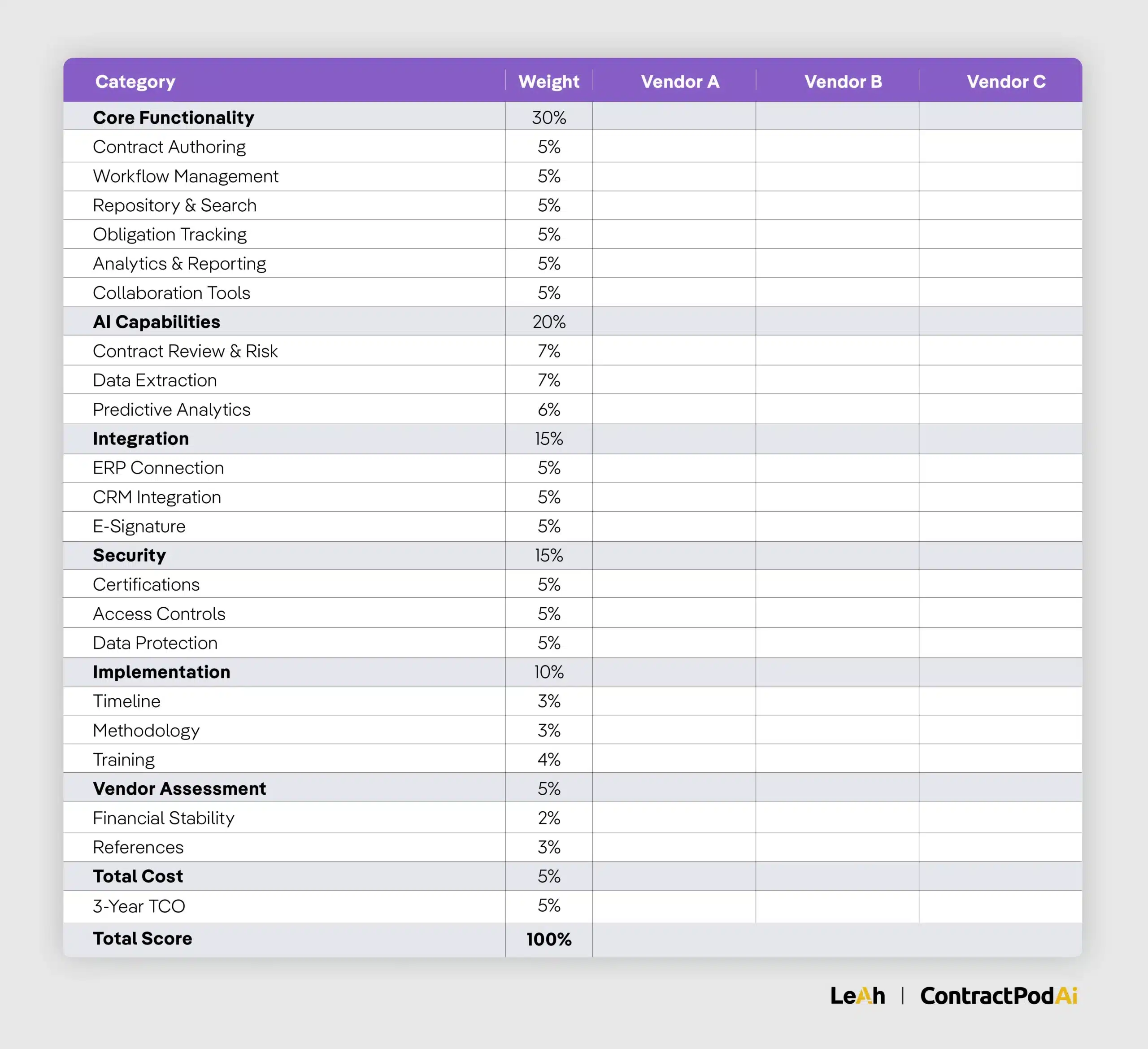
The weighting percentages provided above are examples only and should be adjusted based on your organization’s specific priorities, risk tolerance, contract volume, and strategic objectives.
Pre-Demo Preparation Checklist
Maximize demo value with thorough preparation:
Before the Demo
[ ] Share the RFP responses with demo participants
[ ] Establish shared agreement on the relative importance and priority ranking of CLM features across stakeholders
[ ] Distinguish between essential core functionalities and desirable additional features
[ ] Provide sample contracts for vendors to use
[ ] Create realistic scenarios based on your workflows
[ ] Assign roles to committee members for questions
[ ] Set up recording capability for later review
During the Demo
[ ] Focus on your specific use cases, not generic features
[ ] Use redacted examples of your real-world contracts – particularly when testing AI feature sets
[ ] Request live configuration changes to test flexibility
[ ] Involve actual end users for feedback
[ ] Test integration points with dummy data
[ ] Evaluate user interface and ease of use
[ ] Document questions and concerns immediately
After the Demo
[ ] Gather feedback within 24 hours while fresh
[ ] Score against your evaluation criteria
[ ] List follow-up questions for vendors
[ ] Compare notes across committee members
[ ] Update requirements based on new insights
Vendor Question Bank
Essential questions organized by stakeholder perspective:
For Legal Teams
- How does your AI identify and flag risky clauses?
- Can playbooks be updated by business users without IT?
- Show us obligation extraction from a complex agreement
- How do you handle version control during negotiations?
- What’s your approach to third-party papers?
For Procurement Teams
- How do you track savings and compliance metrics?
- Can suppliers self-serve through a portal?
- Show us bulk operations for contract amendments
- How do you handle multi-tier approval workflows?
- What supplier risk indicators do you track?
For Sales Teams
- Walk through creating a contract from Salesforce
- How quickly can a standard NDA be generated?
- Show mobile access for field sales
- How do you handle contract renewals?
- Can we track deal velocity by contract type?
For IT Teams
- Describe your API architecture and limitations
- What integrations do you offer, and how do you handle common integration challenges?
- What’s your approach to sandbox/production environments?
- Show us your admin console and user management
- How do you handle platform updates and testing?
For Finance Teams
- How do you extract payment terms and obligations?
- Show revenue recognition reporting capabilities
- Can you track contract value and amendments?
- How do you integrate with our ERP?
- What cost allocation features exist?
Red Flags to Watch For
Warning signs that should give you pause:
Technical Red Flags
- Integration only through expensive middleware
- Requires significant IT resources for maintenance
- Limited API functionality or rate limits
- No mobile access or responsive design
Vendor Red Flags
- Vague about roadmap or future development
- High customer churn or recent layoffs
- Outsourced support
- Inflexible contract terms or auto-renewal traps
Implementation Red Flags
- No defined methodology or timeline
- A lack of third party implementation partners
- Requires extensive customization for basic needs
- Limited training or documentation
- No success metrics or SLAs
- Separate costs for each phase
Part 7: Conclusion – Your Path to CLM Success
Reinforcing the Value of a Strong RFP
A well-crafted RFP is an investment that pays dividends throughout your CLM journey. It aligns stakeholders, clarifies requirements, enables objective comparison, and sets expectations for vendor partnership.
The Partnership Mindset
Remember that your CLM vendor becomes a long-term partner in your digital transformation. The RFP process reveals not just product capabilities, but vendor culture, support philosophy, and commitment to your success. Choose a partner who:
- Understands your industry and challenges
- Invests in product innovation and AI advancement
- Provides transparent pricing and contract terms
- Offers robust support and success programs
- Demonstrates flexibility and collaborative approach
- Has a proven track record with customer references
- Can scale across regions and compliance needs
Taking Action
Your CLM transformation starts with a single step. Use this guide and the accompanying templates to:
- Form your selection committee with cross-functional representation
- Document current state challenges and future state vision
- Prioritize requirements based on business value and feasibility
- Create your RFP using our framework and templates
- Engage vendors with confidence and clarity
- Evaluate systematically using objective scoring criteria
- Select your partner based on data-driven insights
Maximizing ROI Through Strategic Selection
The right CLM solution transforms contract management from a cost center to a value driver. With thoughtful selection through a comprehensive RFP process, you’ll achieve:
Immediate Benefits
- Clear Vendor Comparisons: Standardized responses make it easier to evaluate functionality, costs, and compliance side-by-side
- Stronger Negotiation Position: Documented requirements provide leverage to secure better pricing, terms, and service commitments
- Stakeholder Alignment: Involving legal, finance, procurement, and business units early ensures shared goals and smoother buy-in
- Reduced Implementation Surprises: Clear requirements upfront help avoid scope creep, hidden costs, and integration setbacks
Long-Term Benefits
- Sustained Cost Savings & ROI: Selecting the right solution lowers total cost of ownership and ensures negotiated savings are actually realized
- Scalability & Future-Proofing: The chosen CLM grows with contract volume, new business units, geographic expansion, and regulatory change
- Improved Compliance & Risk Control: A well-matched system helps track obligations, enforce policies, and reduce exposure to regulatory or contractual risk
- Enterprise-Wide Value Creation: CLM shifts from a back-office cost center to a strategic enabler that improves forecasting, speeds revenue cycles, and drives better supplier and customer relationships
Final Thoughts
Contract Lifecycle Management transformation delivers measurable business value that extends far beyond process efficiency. While contracts have traditionally been managed through email chains, Word documents, and spreadsheets, modern CLM solutions unlock strategic advantages: faster deal cycles, reduced risk exposure, improved compliance, and data-driven insights that inform better business decisions.
Your RFP is the blueprint for this transformation—a document that captures not just technical requirements, but your vision for how contract management can become a competitive differentiator and revenue driver.
Take the time to get it right. Involve the right people. Ask the tough questions. Demand proof over promises. Your future self—and your organization—will thank you.
Downloadable Resources
Ready to begin your CLM selection journey?
Access our comprehensive CLM RFP Template, complete with:
- 200+ categorized evaluation questions
- Weighted scoring matrix in Excel format
- Vendor comparison framework
- Implementation timeline template
- ROI calculation worksheet
- Change management checklist
The weighting percentages provided in the RFP template are illustrative examples only and should be adjusted based on your organization’s specific priorities, risk tolerance, contract volume, and strategic objectives.
Next Steps
Ready to see how a modern CLM platform addresses your RFP requirements?
ContractPodAi helps legal, procurement, and sales teams accelerate contract velocity while reducing risk. Our agentic AI-powered platform delivers:
- End-to-end contract lifecycle management
- Advanced AI for contract review and extraction
- No-code workflow automation
- Pre-built integrations with leading business systems
- Enterprise-grade security and compliance
Talk to a member of our team to discuss how ContractPodAi aligns with your RFP requirements and unique business needs.
This guide represents industry best practices for CLM selection. For specific guidance tailored to your organization’s unique requirements, we recommend consulting with legal operations professionals and technology advisors.